


Page 145 - TransAT_Tutorial_Manual
P. 145
TransAT Tutorial Manual                                                        4.2. Sloshing


               4.2.4.2   Blocks
               The domain must now be decomposed into several blocks, so that the simulation can run in
               parallel (i.e. on several processors). Indeed, each block is allocated to one processor (but a
               processor can handle several blocks).


                   • Select the Blocks tab

                   • Click
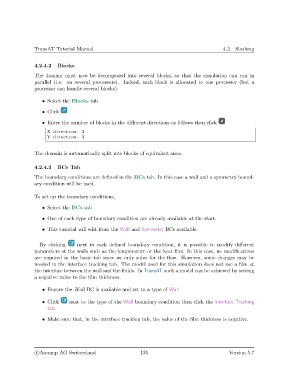
                   • Enter the number of blocks in the different directions as follows then click

                     X d i r e c t i o n : 2
                     Y d i r e c t i o n : 2


               The domain is automatically split into blocks of equivalent sizes.


               4.2.4.3   BCs Tab

               The boundary conditions are defined in the BCs tab. In this case a wall and a symmetry bound-
               ary condition will be used.


               To set up the boundary conditions,

                   • Select the BCs tab
                   • One of each type of boundary condition are already available at the start.

                   • This tutorial will edit from the Wall and Symmetry BCs available.


                  By clicking    next to each defined boundary condition, it is possible to modify different
               parameters at the walls such as the temperature or the heat flux. In this case, no modifications
               are required in the basic tab since we only solve for the flow. However, some changes may be
               needed in the interface tracking tab. The model used for this simulation does not use a film at
               the interface between the wall and the fluids. In TransAT such a model can be achieved by setting
               a negative value to the film thickness.

                   • Ensure the Wall BC is available and set to a type of Wall

                   • Click    next to the type of the Wall boundary condition then click the Interface Tracking
                     tab.

                   • Make sure that, in the interface tracking tab, the value of the film thickness is negative.


                c
Ascomp AG Switzerland                    135                                  Version 5.7

