


Page 232 - TransAT_Tutorial_Manual
P. 232
TransAT Tutorial Manual                                  5.3. Transport of particles in a pipe


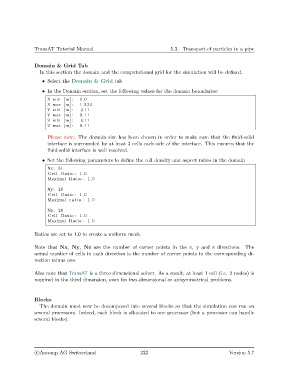
               Domain & Grid Tab
                  In this section the domain and the computational grid for the simulation will be defined.

                   • Select the Domain & Grid tab
                   • In the Domain section, set the following values for the domain boundaries:
                     X min [m] :  0.0
                     X max [m] :  1.524
                     Y min [m] : −0.11
                     Y max [m] :  0.11
                     Z min [m] : −0.11
                     Z max [m] :  0.11

                     Please note: The domain size has been chosen in order to make sure that the fluid-solid
                     interface is surrounded by at least 3 cells each side of the interface. This ensures that the
                     fluid-solid interface is well resolved.
                   • Set the following parameters to define the cell density and aspect ratios in the domain
                     Nx: 51
                     Cell Ratio : 1.0
                     Maximal Ratio : 1.0

                     Ny: 26
                     Cell Ratio : 1.0
                     Maximal r a t i o : 1.0
                     Nz : 26
                     Cell Ratio : 1.0
                     Maximal Ratio : 1.0

               Ratios are set to 1.0 to create a uniform mesh.


               Note that Nx, Ny, Nz are the number of corner points in the x, y and z directions. The
               actual number of cells in each direction is the number of corner points in the corresponding di-
               rection minus one.


               Also note that TransAT is a three-dimensional solver. As a result, at least 1 cell (i.e. 2 nodes) is
               required in the third dimension, even for two-dimensional or axisymmetrical problems.


               Blocks
                  The domain must now be decomposed into several blocks so that the simulation can run on
               several processors. Indeed, each block is allocated to one processor (but a processor can handle
               several blocks).


                c
Ascomp AG Switzerland                    222                                  Version 5.7

